Dataset specification · Production cohort
1,000 speakers of Bengali Telephony Speech
A production cohort build of 1,000 speakers of Bengali telephony speech. Generalisation across speakers, which is what actually drives real-world ASR robustness. Speech captured over a real telephony path — a genuine call through the network, not studio audio downsampled afterwards to imitate one.

- Volume
- 1,000 speakers
- Scale
- Production cohort
- Per speaker
- 10–20 minutes of accepted audio per speaker
- Accepted yield
- 50–60% of recorded time is accepted
How Bengali telephony speech is captured
Speech captured over a real telephony path — a genuine call through the network, not studio audio downsampled afterwards to imitate one.
Scenario-driven calls between a caller and an agent or IVR flow, each leg recorded separately, across a deliberate spread of handsets and network conditions.
Yield at this style: 50–60% of recorded time is accepted. Dropped calls, network artefacts beyond tolerance and unusable legs are discarded. Real network conditions are the point of the style and also its main cost.
The specification
| Field | Value |
|---|---|
| Language | Bengali (bn-IN, Bengali) |
| Volume | 1,000 speakers |
| Equivalent | 500 hours at 30 minutes per speaker |
| Speech type | Telephony Speech |
| Per speaker | 10–20 minutes of accepted audio per speaker |
| Sample rate | 8 kHz narrowband, matching what a deployed contact-centre model actually receives |
| Codec | G.711 and AMR-NB captured explicitly, with the codec recorded per call in the manifest |
| Legs | Caller and agent recorded on separate legs, never as a mixed call recording |
| Network conditions | Handset type, network carrier and packet-loss events logged per call |
| Dialects | Kolkata standard (Rarhi), Sylheti-influenced, Rangpuri / North Bengal, Medinipuri |
| Transcription | Verbatim, native-speaker, second-pass reviewed |
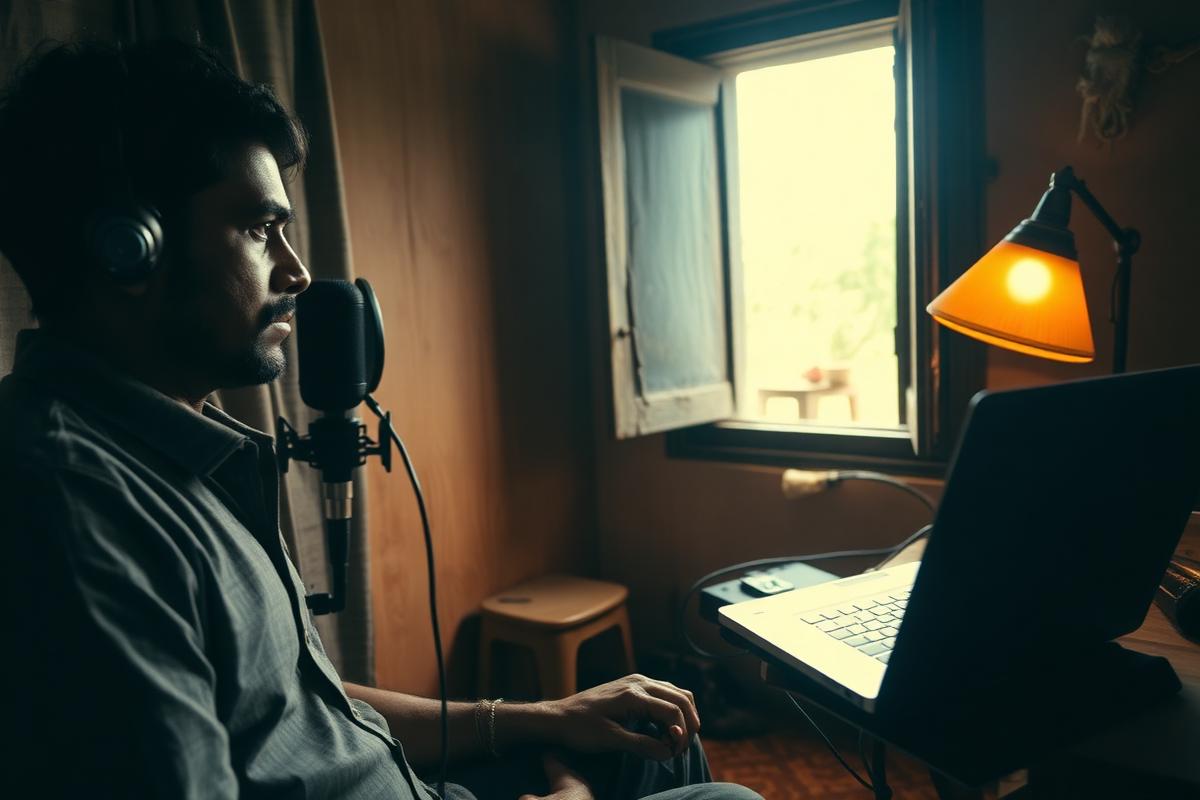
Designing the call flows for Bengali
- Call scenarios drawn from real contact-centre intents: balance enquiry, complaint, booking change, escalation
- IVR flows scripted with deliberate mis-entry and barge-in paths, since those are where deployed systems fail
- Handset spread specified up front — low-end Android, feature phone, landline — because handset variance is a real acoustic axis
- Background conditions varied on purpose: street, vehicle, indoor, since real callers are rarely in quiet rooms
- Built against Bengali specifically: Inherent vowel is realised as /ɔ/ or /o/, which breaks G2P rules copied from Devanagari-based systems
- Code-mixing handled explicitly rather than edited out — Kolkata professional speech mixes English heavily; rural West Bengal much less. A single 'Bengali' dataset without register tags conflates two very different acoustic and lexical distributions.
Running a production cohort Bengali build
Nine to twelve weeks, with recruitment running continuously rather than in a front-loaded phase.
Six to eight batches, speaker-disjoint by construction so held-out speakers are genuinely held out.
Tag every speaker as Indian Bengali and record district of origin; mixing in Bangladeshi speech without tags is a common and costly dataset defect.
| Parameter | At this volume |
|---|---|
| Cities | Six to eight — Kolkata, Siliguri, Durgapur, Agartala, Asansol |
| Studios | Eight rooms plus two mobile rigs |
| Recruiters | Eight coordinators, one regional manager |
| Audio yield | ~500 hours at 30 minutes per speaker |
| Sessions per day | 45–55 |
| Team | 1 programme lead, 1 regional manager, 8 coordinators, 14 engineers, 25 transcribers, 3 QA leads |
Cohort design
At 1,000 speakers the quota matrix is enforced per cell, not in aggregate. Every dialect, age and gender combination carries its own target and is signed off individually before final acceptance, because an aggregate 50/50 split can hide a cell that was never filled at all.
Recruitment must be stratified by handset and carrier as well as by dialect, which adds a screening axis the other styles do not have.
| Dimension | Typical split | Why it matters for Bengali |
|---|---|---|
| Gender | 50 / 50 | Pitch range differences change acoustic model behaviour; unbalanced cohorts bias recognition |
| Age | 18-25: 30%, 26-40: 40%, 41-60: 30% | Older speakers retain conservative Bengali forms that younger urban speakers have lost |
| Region | West Bengal / Tripura / Assam (Barak Valley) and others | Dialect spread across 5 recognised varieties |
| Education | Mixed, including below-graduate | Prompt-reading fluency correlates with education and skews prosody |
| Condition | Studio / quiet room / field | Match the noise profile of your deployment |
Bengali-specific considerations
- Inherent vowel is realised as /ɔ/ or /o/, which breaks G2P rules copied from Devanagari-based systems
- Kolkata professional speech mixes English heavily; rural West Bengal much less. A single 'Bengali' dataset without register tags conflates two very different acoustic and lexical distributions.
- Indian Bengali is under-collected relative to Bangladeshi Bengali, and North Bengal and Tripura varieties are almost entirely missing.
Quality gates for telephony speech
- Codec and sample rate verified per file, rejecting any studio audio that has been downsampled to fake a telephony path
- Echo and double-talk checked on both legs
- DTMF events verified against the call log
- Level normalisation applied per leg, since handset output levels vary far more than studio microphones do
- Three sibilant characters chosen inconsistently for the same sound
- Bangladeshi vs Indian Bengali orthographic conventions mixed within one dataset
100% technical QA, 10% content QA stratified by city and coordinator, with voice-based duplicate detection across the whole cohort.
What goes wrong on telephony speech sessions
- Studio audio downsampled to 8 kHz and passed off as telephony, which has none of the codec or packet-loss characteristics that matter
- Echo and double-talk that make the agent leg unusable
- Carrier and handset monoculture, producing a corpus that only represents one acoustic path
- Over-clean recordings from participants who move somewhere quiet to take the call, defeating the purpose
Risks at production cohort in Bengali
Cost at this band is driven by: Number of distinct demographic cells rather than total speakers.
- Speaker-disjoint splits are only trustworthy if duplicate detection is voice-based rather than ID-based, since one person can present two identities
- Coordinator-level demographic bias becomes measurable at this size and should be reported, not smoothed over
- Bengali carries 5 recognised varieties across West Bengal, Tripura, Assam (Barak Valley), so the quota matrix is wider than the headline volume suggests
- Indian Bengali is under-collected relative to Bangladeshi Bengali, and North Bengal and Tripura varieties are almost entirely missing.
Deliverables
- WAV audio to your naming convention, with the per-file manifest
- Verbatim Bengali transcripts with utterance-level timestamps
- Call metadata: duration, codec, handset class, carrier, packet-loss events
- Intent label per call and per turn
- DTMF and hold, transfer and barge-in events
- Agent and caller leg identifiers
- Per-speaker metadata: age band, gender, region, dialect, education band
- Consent records mapped to speaker IDs
- QA report with pass rates, rejection reasons and agreement statistics
- Speaker-disjoint train / dev / test splits on request
What this trains, and what it does not
- Contact-centre and IVR ASR
- Voice bots operating over the phone network
- Intent classification on narrowband audio
- Robustness to codec and packet loss
Narrowband telephony audio is the wrong input for TTS or any wideband model — the frequency content simply is not there. Use it for models that will be deployed on a phone line and nothing else.
Frequently asked
Is 1,000 speakers of Bengali enough?
Enough for production ASR generalisation and for a speaker-verification corpus with meaningful negative pairs.
Why telephony speech rather than another speech type?
Contact-centre and IVR ASR, Voice bots operating over the phone network, Intent classification on narrowband audio are what this style is the right input for. Narrowband telephony audio is the wrong input for TTS or any wideband model — the frequency content simply is not there. Use it for models that will be deployed on a phone line and nothing else.
How long does a production cohort Bengali build take?
Nine to twelve weeks, with recruitment running continuously rather than in a front-loaded phase. Six to eight batches, speaker-disjoint by construction so held-out speakers are genuinely held out.
What does 1,000 speakers of Bengali telephony speech cost?
Quoted per delivered hour against this specification. At this band the drivers are number of distinct demographic cells rather than total speakers. Send the spec and you get one fixed figure.
How much QA is applied at this volume?
100% technical QA, 10% content QA stratified by city and coordinator, with voice-based duplicate detection across the whole cohort.
Quote this Bengali dataset
1,000 speakers, telephony speech, Bengali — production cohort. Adjust anything and send it.