Sample · اردو
Free Urdu speech data sample
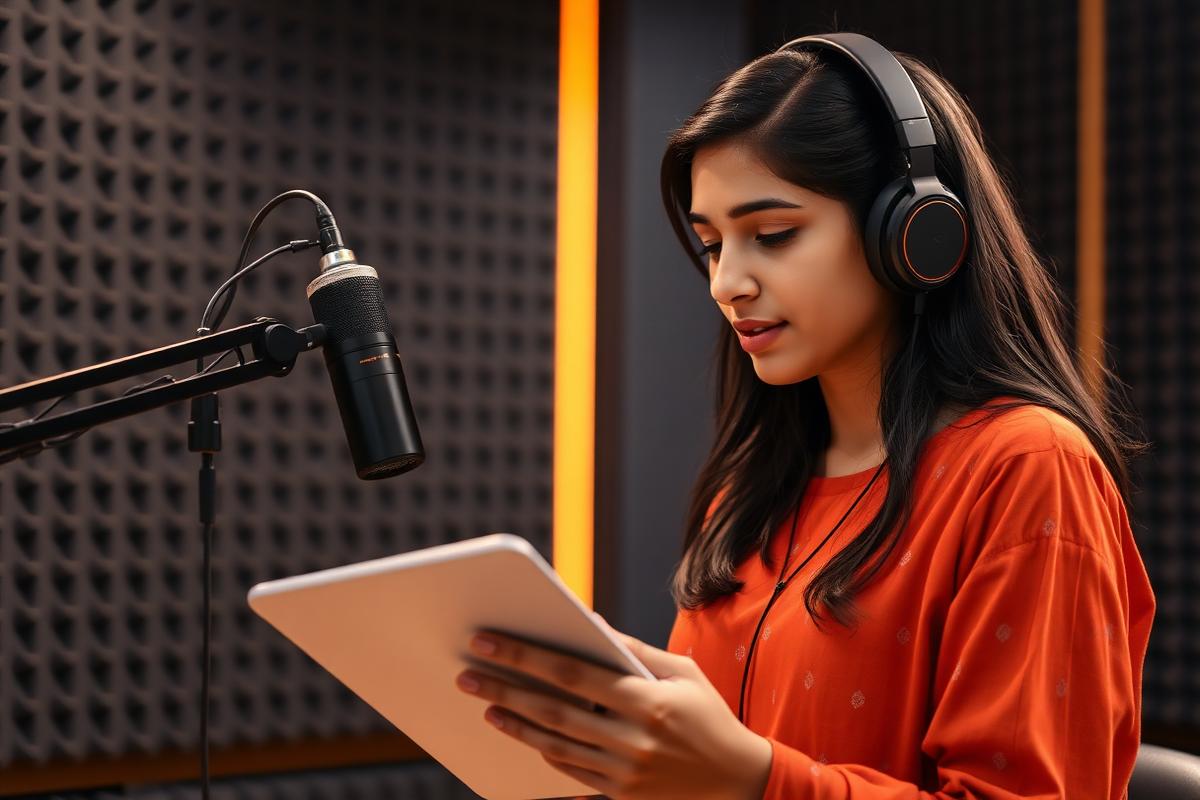
Thirty minutes of Urdu audio, recorded to your specification with transcripts and full metadata, at no cost. It exists so you can judge us on files rather than on claims.
- Sample size
- ~30 minutes
- Cost
- Free
- Turnaround
- 5-8 working days
- Formats
- WAV 48 kHz + transcript + metadata
What the sample contains
- Urdu audio from at least four speakers with a mixed gender and age spread
- Coverage of Dakhini (Hyderabad), Lucknawi, Dehlvi where your spec calls for dialect breadth
- Verbatim transcripts in Perso-Arabic (Nastaliq), with a romanised parallel transcript on request
- Per-file metadata: speaker ID, age band, gender, district, device, environment and SNR
- A short QA report showing how the files were checked before they were sent
How to specify it
| Decision | Options | Default if you do not say |
|---|---|---|
| Speech type | Scripted / spontaneous / conversational / telephony | Scripted plus a spontaneous block |
| Environment | Studio / quiet room / field / call path | Studio and quiet room, split |
| Sample rate | 48 kHz, 16 kHz, 8 kHz | 48 kHz mastered, 16 kHz derived |
| Dialects | Dakhini (Hyderabad), Lucknawi, Dehlvi | Standard variety plus one regional |
| Annotation | Verbatim / timestamps / speaker turns / event tags | Verbatim with timestamps |
The sample is only useful if it looks like the data you would actually buy. Send the spec you would put in a purchase order and we record against that.
What to test it against
- Run it through your existing ASR or TTS pipeline and read the error breakdown by speaker and dialect
- Check how Urdu code-mixing is transcribed: Spoken Urdu and spoken Hindi are largely mutually intelligible; the distinction is mainly lexical and orthographic. Decide up front whether transcription is in Nastaliq, Devanagari, or both.
- Check the transcription convention against your tokeniser — Right-to-left Nastaliq tooling errors and diacritic loss is the usual failure point
- Confirm the metadata is complete enough to filter and stratify by
What a Urdu sample usually exposes
Urdu has roughly 51 million speakers across Uttar Pradesh, Telangana, Bihar, and models trained on generic multilingual data typically fail on the same things each time.
Indian Urdu specifically, and Dakhini in particular, are absent from public data dominated by Pakistani Urdu broadcast speech.
- Phonetics your acoustic model may not have seen: Shares most phonology with Hindi but adds Perso-Arabic phonemes (/q/, /x/, /ɣ/, /z/, /f/) that many speakers merge
- Utterance types worth sampling separately: Dakhini spontaneous conversation from Hyderabad, Dual-script transcription sets (Nastaliq plus Devanagari), Formal and colloquial register pairs
- Recording geography in the sample: Hyderabad, Lucknow, Delhi
What happens after
Nothing automatic. If the sample works, we scope the full build against the same specification and quote a fixed price. If it does not, tell us what failed — that feedback is more useful to us than a polite no.
Fix the script decision before fielding; retro-transcribing a Nastaliq dataset into Devanagari after delivery costs as much as the original transcription pass.
Frequently asked
Is the Urdu sample really free?
Yes. There is no charge and no obligation. We cap it at roughly 30 minutes because that is enough to judge quality without becoming an unpaid production run.
Can we use the sample data commercially?
The sample is licensed for evaluation. Full commercial rights and IP transfer come with a paid delivery, including a paid pilot.
How long does it take?
Five to eight working days from an agreed specification, depending on how narrow the speaker cohort is.
Can we specify our own script?
Yes. Send your prompts, wake words or domain vocabulary and we record those instead of our standard set.
Related pages
Request your free Urdu sample
Send the specification you would buy against. Thirty minutes of audio, transcripts and metadata come back within a week.