Dataset specification · Domain scale
250 hours of Hindi Conversational Speech
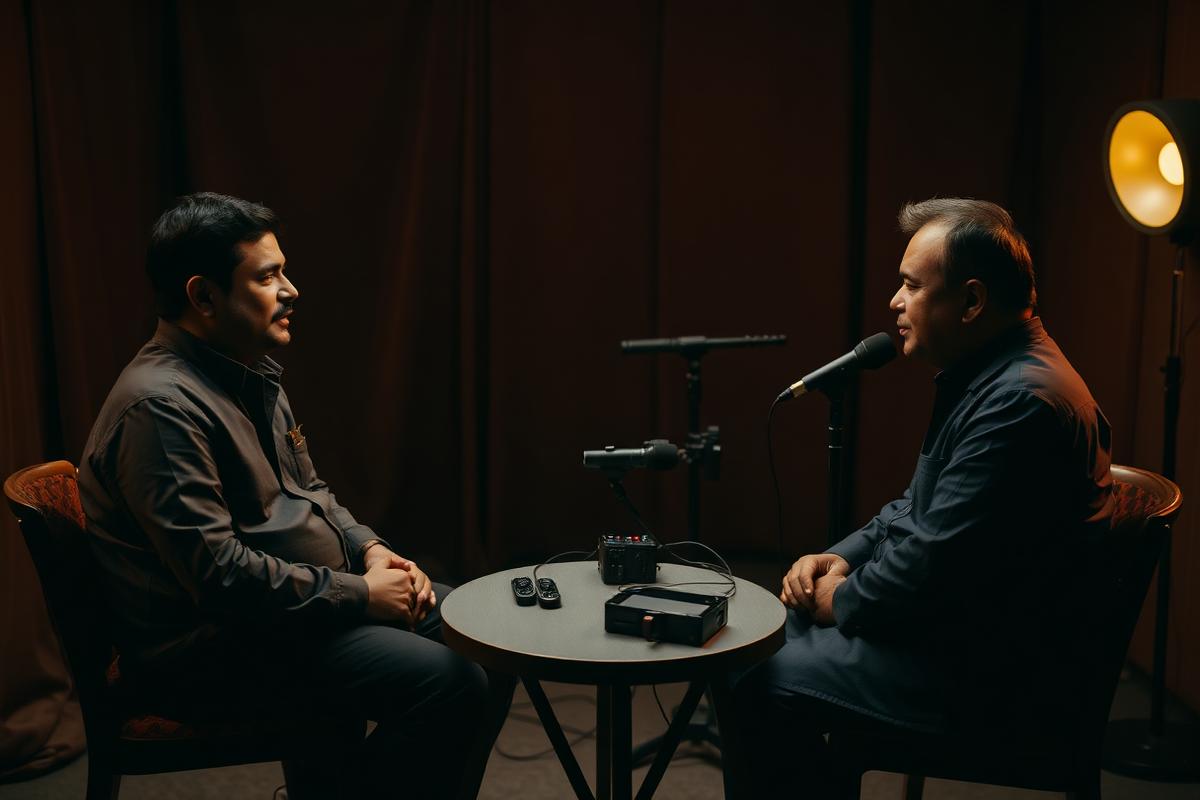
A domain scale build of 250 hours of Hindi conversational speech. Fine-tuning a production model for a specific domain, accent range or deployment condition. Two speakers hold an unscripted conversation seeded with a scenario, recorded on separate channels so overlap and turn-taking survive into the delivered files.
- Volume
- 250 hours
- Scale
- Domain scale
- Per speaker
- 20–30 minutes of accepted audio per speaker, in pairs
- Accepted yield
- 55–65% of recorded time is accepted
How Hindi conversational speech is captured
Two speakers hold an unscripted conversation seeded with a scenario, recorded on separate channels so overlap and turn-taking survive into the delivered files.
A 45–60 minute paired session with both speakers on isolated microphones, either in adjacent treated rooms or split-mic in one room with bleed measured and logged.
Yield at this style: 55–65% of recorded time is accepted. Overlap regions, crosstalk bleed and one-sided stretches all cost delivered time. The lowest-yield studio style we run, and priced accordingly.
The specification
| Field | Value |
|---|---|
| Language | Hindi (hi-IN, Devanagari) |
| Volume | 250 hours |
| Equivalent | 500 speakers at 30 minutes each, or 250 speakers at one hour each |
| Speech type | Conversational Speech |
| Per speaker | 20–30 minutes of accepted audio per speaker, in pairs |
| Channels | Two, one per speaker, never mixed down before delivery |
| Channel isolation | Bleed measured per session and logged; sessions over threshold are re-recorded |
| Overlap | Preserved, timestamped and labelled rather than edited out |
| File granularity | Per-channel session WAV plus a turn-level manifest with speaker IDs |
| Dialects | Khari Boli, Awadhi, Braj, Bhojpuri-influenced Hindi |
| Transcription | Verbatim, native-speaker, second-pass reviewed |
Designing the scenarios for Hindi
- Scenario seeds rather than scripts — a disagreement to resolve, a plan to make, an experience to compare
- Pairing designed deliberately: familiar pairs produce natural interruption, stranger pairs produce polite turn-taking, and you need both
- Scenarios that invite disagreement, because agreeable conversation produces almost no overlap to train on
- Register mixed across pairs so the corpus is not uniformly formal
- Built against Hindi specifically: Four-way stop contrast (voiced/voiceless x aspirated/unaspirated) that collapses in models trained on English-first acoustic units
- Code-mixing handled explicitly rather than edited out — Urban Hindi speech is Hinglish in practice. Expect 15-40% English tokens in spontaneous speech: numbers, brands, technology terms, and whole clause switches. Any Hindi corpus that excludes English tokens will not match production traffic.
Running a domain scale Hindi build
Six to eight weeks. Beyond three cities the bottleneck moves from recruitment to transcription throughput, which is why the transcriber count rises faster than the engineer count.
Four to five batches on a fortnightly cadence, sequenced so the dialects you care about most land first.
Largest recruitment pool in the network. A 1,000-speaker Hindi cohort with balanced gender and 18-45 age bands is typically fielded across four cities to avoid a single-city accent bias.
| Parameter | At this volume |
|---|---|
| Cities | Three to four — Delhi, Lucknow, Jaipur, Patna |
| Studios | Three to four rooms plus one mobile rig |
| Recruiters | Four coordinators under one programme lead |
| Speakers | ~500–600 |
| Sessions per day | 25–30 nationally |
| Team | 1 programme lead, 4 coordinators, 8 engineers, 14 transcribers, 2 QA leads |
Cohort design
At 250 hours quotas are enforced per dialect and reconciled fortnightly. Aggregate demographics are reported per batch so drift is visible while there is still time to correct it.
Effectively doubles recruitment load, since speakers are booked in matched pairs and a single drop-out cancels the whole session. Plan on 20–25% over-recruitment.
| Dimension | Typical split | Why it matters for Hindi |
|---|---|---|
| Gender | 50 / 50 | Pitch range differences change acoustic model behaviour; unbalanced cohorts bias recognition |
| Age | 18-25: 30%, 26-40: 40%, 41-60: 30% | Older speakers retain conservative Hindi forms that younger urban speakers have lost |
| Region | Uttar Pradesh / Bihar / Madhya Pradesh and others | Dialect spread across 7 recognised varieties |
| Education | Mixed, including below-graduate | Prompt-reading fluency correlates with education and skews prosody |
| Condition | Studio / quiet room / field | Match the noise profile of your deployment |
Hindi-specific considerations
- Four-way stop contrast (voiced/voiceless x aspirated/unaspirated) that collapses in models trained on English-first acoustic units
- Urban Hindi speech is Hinglish in practice. Expect 15-40% English tokens in spontaneous speech: numbers, brands, technology terms, and whole clause switches. Any Hindi corpus that excludes English tokens will not match production traffic.
- Public Hindi corpora skew heavily towards read newspaper text from educated urban speakers in Delhi and NCR. Rural Bihar and eastern UP speech, elderly speakers, and low-literacy speakers reading prompts aloud are largely absent.
Quality gates for conversational speech
- Channel bleed measured on every session and rejected above the agreed threshold
- Diarisation labels verified against the isolated channels rather than inferred from the mix
- Turn boundaries and overlap regions checked by a native listener
- Speaking-time balance per pair audited, so a dominant speaker does not silently halve the session's value
- Inconsistent Devanagari vs romanised spelling for the same English loan word
- Nukta characters (क़ ख़ ग़ ज़ फ़) applied inconsistently by transcribers
100% technical QA, 15% content QA with stratified sampling across city, dialect and transcriber, so no single team's output goes unchecked.
What goes wrong on conversational speech sessions
- Crosstalk bleed that makes clean per-speaker training targets impossible to recover afterwards
- One speaker dominating, leaving a pair that delivers half the expected audio
- Unnatural politeness between strangers, producing clean but unrepresentative turn-taking
- Scheduling attrition — both speakers have to show up, so no-show rates compound rather than add
Risks at domain scale in Hindi
Cost at this band is driven by: Transcription depth — verbatim with disfluencies costs materially more than clean-read transcription; Number of distinct dialect quotas rather than raw hours.
- Transcription becomes the critical path and stays there for the rest of the volume bands
- Coordinator turnover mid-build causes quota drift that is only visible in the final demographic report unless it is audited weekly
- Hindi carries 7 recognised varieties across Uttar Pradesh, Bihar, Madhya Pradesh, so the quota matrix is wider than the headline volume suggests
- Public Hindi corpora skew heavily towards read newspaper text from educated urban speakers in Delhi and NCR. Rural Bihar and eastern UP speech, elderly speakers, and low-literacy speakers reading prompts aloud are largely absent.
Deliverables
- WAV audio to your naming convention, with the per-file manifest
- Verbatim Devanagari transcripts with utterance-level timestamps
- Speaker-turn segmentation with start and end timestamps
- Overlap regions marked with participating speaker IDs
- Backchannel and interruption markers
- Per-pair relationship metadata: familiar or stranger
- Per-speaker metadata: age band, gender, region, dialect, education band
- Consent records mapped to speaker IDs
- QA report with pass rates, rejection reasons and agreement statistics
- Speaker-disjoint train / dev / test splits on request
What this trains, and what it does not
- Speaker diarisation
- Meeting and multi-party ASR
- Turn-taking and endpointing for voice agents
- Speaker separation and target-speaker extraction
Two-party conversation does not generalise to multi-party meetings with four or more speakers, where overlap statistics change substantially. Specify that case separately.
Frequently asked
Is 250 hours of Hindi enough?
Enough to shift word error rate meaningfully on a domain-specific deployment. For a general-purpose model in a low-resource language, still a starting layer.
Why conversational speech rather than another speech type?
Speaker diarisation, Meeting and multi-party ASR, Turn-taking and endpointing for voice agents are what this style is the right input for. Two-party conversation does not generalise to multi-party meetings with four or more speakers, where overlap statistics change substantially. Specify that case separately.
How long does a domain scale Hindi build take?
Six to eight weeks. Beyond three cities the bottleneck moves from recruitment to transcription throughput, which is why the transcriber count rises faster than the engineer count. Four to five batches on a fortnightly cadence, sequenced so the dialects you care about most land first.
What does 250 hours of Hindi conversational speech cost?
Quoted per delivered hour against this specification. At this band the drivers are transcription depth — verbatim with disfluencies costs materially more than clean-read transcription and number of distinct dialect quotas rather than raw hours. Send the spec and you get one fixed figure.
How much QA is applied at this volume?
100% technical QA, 15% content QA with stratified sampling across city, dialect and transcriber, so no single team's output goes unchecked.
Quote this Hindi dataset
250 hours, conversational speech, Hindi — domain scale. Adjust anything and send it.