Dataset specification · Pilot scale
50 hours of Hinglish Spontaneous Speech
A pilot scale build of 50 hours of Hinglish spontaneous speech. Proving that the specification survives contact with real speakers before anyone commits a budget to it. Speakers talk unscripted on prompted topics — describing a process, recounting an event, arguing a position — with a moderator who prompts but does not lead.

- Volume
- 50 hours
- Scale
- Pilot scale
- Per speaker
- 25–40 minutes of accepted audio per speaker
- Accepted yield
- 60–70% of recorded time is accepted
How Hinglish spontaneous speech is captured
Speakers talk unscripted on prompted topics — describing a process, recounting an event, arguing a position — with a moderator who prompts but does not lead.
A 60-minute session covering six to eight topics, recorded continuously and segmented afterwards into utterances at natural pause boundaries.
Yield at this style: 60–70% of recorded time is accepted. Long silences, moderator speech and abandoned topics are cut in post, so recorded hours run well ahead of delivered hours. Budget for the gap.
The specification
| Field | Value |
|---|---|
| Language | Hinglish (hi-Latn-IN, Devanagari + Latin) |
| Volume | 50 hours |
| Equivalent | 100 speakers at 30 minutes each, or 50 speakers at one hour each |
| Speech type | Spontaneous Speech |
| Per speaker | 25–40 minutes of accepted audio per speaker |
| File granularity | Session-length WAV plus segmented utterance files with offsets into the parent |
| Segmentation | Pause-boundary segmentation, reviewed by a native listener rather than left to VAD |
| Moderator channel | Recorded separately and excluded from the delivered speaker audio |
| Disfluency convention | Filled pauses, repetitions and false starts transcribed, not normalised away |
| Dialects | Delhi corporate Hinglish, Mumbai Bambaiya, Call-centre register, Youth/social media register |
| Transcription | Verbatim, native-speaker, second-pass reviewed |
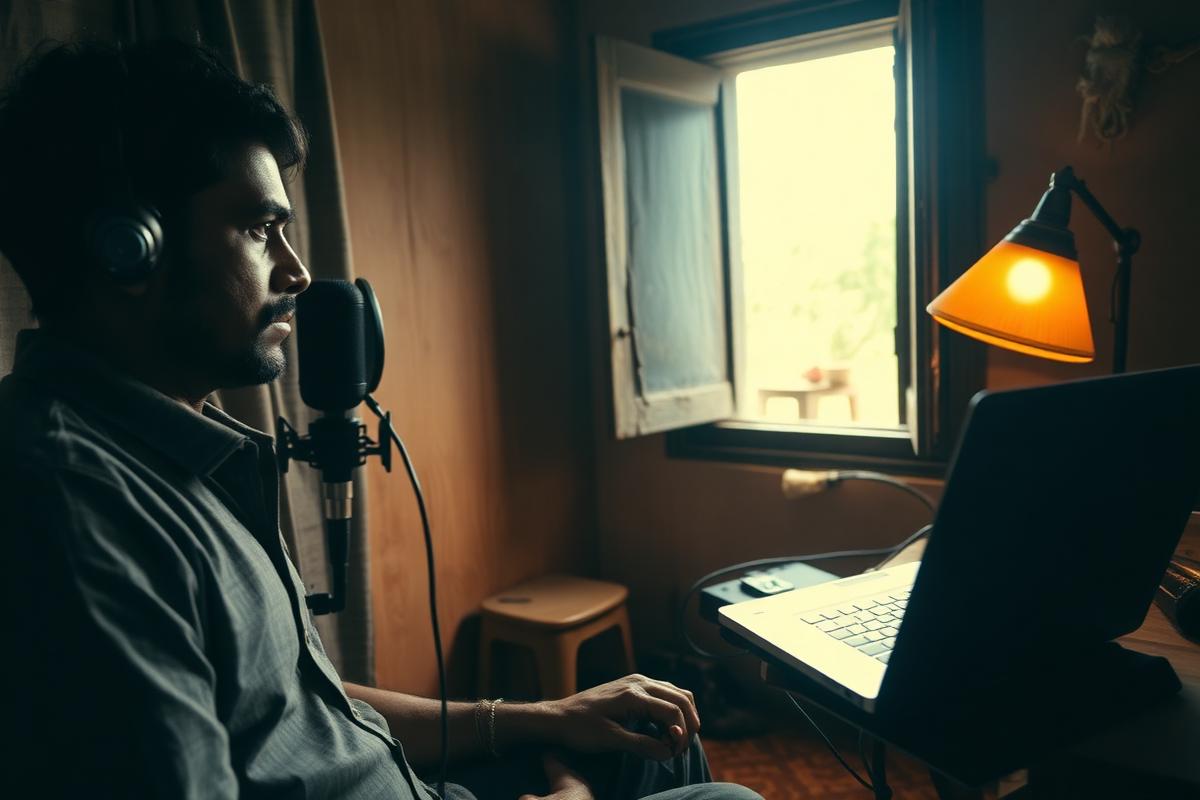
Designing the topic bank for Hinglish
- Topic banks graded by familiarity, so speakers across education and occupation bands all have something to say
- Open prompts only — anything answerable with yes or no produces thirty seconds of audio and a stalled session
- Culturally grounded topics per region, since a prompt that works in Mumbai can draw blank looks in Guwahati
- Topic rotation across the cohort so the corpus does not over-represent a handful of subjects
- Built against Hinglish specifically: Intra-sentential switching means English words carry Indian phonology, so English acoustic models mis-transcribe them
- Code-mixing handled explicitly rather than edited out — Hinglish is the code-mixing case itself. Typical urban customer-support speech is 30-60% English tokens embedded in Hindi grammar, with switching several times per utterance.
Running a pilot scale Hinglish build
Three to four weeks from signed specification. Recruitment is the critical path, not recording — the studio time itself is under two weeks.
Two batches: a 10-hour first batch in week two so you can run it through your pipeline while the rest is still recording, then the balance on completion.
Recruit by switching behaviour, not by language proficiency. Screening recordings are used to confirm speakers switch naturally rather than performing one language.
| Parameter | At this volume |
|---|---|
| Cities | One, usually the densest pool for the language — Delhi, Gurugram |
| Studios | A single treated room |
| Recruiters | One coordinator |
| Speakers | ~100–120 |
| Sessions per day | 6–8 |
| Team | 1 coordinator, 2 engineers, 3 transcribers |
Cohort design
At 50 hours the cohort is deliberately simplified: two or three dialect groups rather than the full spread, with quotas enforced in aggregate. A build this size cannot support per-cell targets and should not claim to.
Screening is for willingness to talk, not literacy, which opens the cohort to speakers a scripted protocol would exclude. Expect to over-recruit by 15% for speakers who freeze on the day.
| Dimension | Typical split | Why it matters for Hinglish |
|---|---|---|
| Gender | 50 / 50 | Pitch range differences change acoustic model behaviour; unbalanced cohorts bias recognition |
| Age | 18-25: 30%, 26-40: 40%, 41-60: 30% | Older speakers retain conservative Hinglish forms that younger urban speakers have lost |
| Region | Delhi NCR / Mumbai / Bengaluru and others | Dialect spread across 4 recognised varieties |
| Education | Mixed, including below-graduate | Prompt-reading fluency correlates with education and skews prosody |
| Condition | Studio / quiet room / field | Match the noise profile of your deployment |
Hinglish-specific considerations
- Intra-sentential switching means English words carry Indian phonology, so English acoustic models mis-transcribe them
- Hinglish is the code-mixing case itself. Typical urban customer-support speech is 30-60% English tokens embedded in Hindi grammar, with switching several times per utterance.
- Almost no public corpus contains genuine intra-sentential Hindi-English switching with per-token language tags. This is the highest-value gap for anyone building Indian conversational AI.
Quality gates for spontaneous speech
- Segment boundary review — bad boundaries produce truncated words that poison training more than they help
- Disfluency transcription consistency audited across transcribers, since conventions drift fast on this style
- Moderator speech confirmed absent from delivered segments
- Topic distribution checked per speaker so one dominant subject does not skew the language model
- Whether English tokens are written in Latin or transliterated into Devanagari must be fixed by rule, not left to annotators
- Language-ID tagging per token is required for training but is skipped by most vendors
100% content QA. At this volume there is no reason to sample, and a pilot exists precisely to surface specification problems.
What goes wrong on spontaneous speech sessions
- Speakers who dry up after a minute, leaving sessions that look complete by duration but are mostly silence
- Drift into a reading register when a speaker becomes self-conscious about the microphone
- Moderator over-prompting, which turns a monologue corpus into an interview corpus
- Transcriber normalisation — quietly cleaning up disfluencies destroys the exact signal this style exists to capture
Risks at pilot scale in Hinglish
Cost at this band is driven by: Fixed setup cost is amortised over very few hours, so the per-hour rate is at its highest here; Narrow demographic requirements bite hardest at small cohort sizes.
- The specification itself is usually the risk, not delivery — pilots exist to find the clauses that do not survive contact with real speakers
- A single-city cohort will not represent the language nationally, and reading pilot results as national is the most common mistake at this band
- Hinglish carries 4 recognised varieties across Delhi NCR, Mumbai, Bengaluru, so the quota matrix is wider than the headline volume suggests
- Almost no public corpus contains genuine intra-sentential Hindi-English switching with per-token language tags. This is the highest-value gap for anyone building Indian conversational AI.
Deliverables
- WAV audio to your naming convention, with the per-file manifest
- Verbatim Devanagari + Latin transcripts with utterance-level timestamps
- Filled-pause and false-start markers
- Segment offsets into the parent session file
- Topic label per segment
- Speech-rate and pause-density statistics per speaker
- Per-speaker metadata: age band, gender, region, dialect, education band
- Consent records mapped to speaker IDs
- QA report with pass rates, rejection reasons and agreement statistics
- Speaker-disjoint train / dev / test splits on request
What this trains, and what it does not
- Robust ASR for real user speech
- Language modelling on natural syntax
- Disfluency detection and removal
- Prosody and speech-rate modelling
Phonetic balance cannot be guaranteed — speakers say what they say. If you need specific phone contexts or a controlled lexicon, this style has to be paired with a scripted layer.
Frequently asked
Is 50 hours of Hinglish enough?
Enough to validate a specification, benchmark a vendor and produce a small evaluation set. Not enough to move a production model's error rate.
Why spontaneous speech rather than another speech type?
Robust ASR for real user speech, Language modelling on natural syntax, Disfluency detection and removal are what this style is the right input for. Phonetic balance cannot be guaranteed — speakers say what they say. If you need specific phone contexts or a controlled lexicon, this style has to be paired with a scripted layer.
How long does a pilot scale Hinglish build take?
Three to four weeks from signed specification. Recruitment is the critical path, not recording — the studio time itself is under two weeks. Two batches: a 10-hour first batch in week two so you can run it through your pipeline while the rest is still recording, then the balance on completion.
What does 50 hours of Hinglish spontaneous speech cost?
Quoted per delivered hour against this specification. At this band the drivers are fixed setup cost is amortised over very few hours, so the per-hour rate is at its highest here and narrow demographic requirements bite hardest at small cohort sizes. Send the spec and you get one fixed figure.
How much QA is applied at this volume?
100% content QA. At this volume there is no reason to sample, and a pilot exists precisely to surface specification problems.
Quote this Hinglish dataset
50 hours, spontaneous speech, Hinglish — pilot scale. Adjust anything and send it.